The Forgotten Sisters Behind ‘Happy Birthday to You’
Thank you, Tim, and Goddesses rest your soul xxx
It’s mine, today :) 52… Because I’ve got an at home dinner and movie date with my love I’ll all but copy-paste a beautiful article by Kelly B. Gormly I found about the origins of the iconic ‘Happy Birthday to You’ tune today and return to my 50 euro bottle of Sake birthday gift. Cheers!
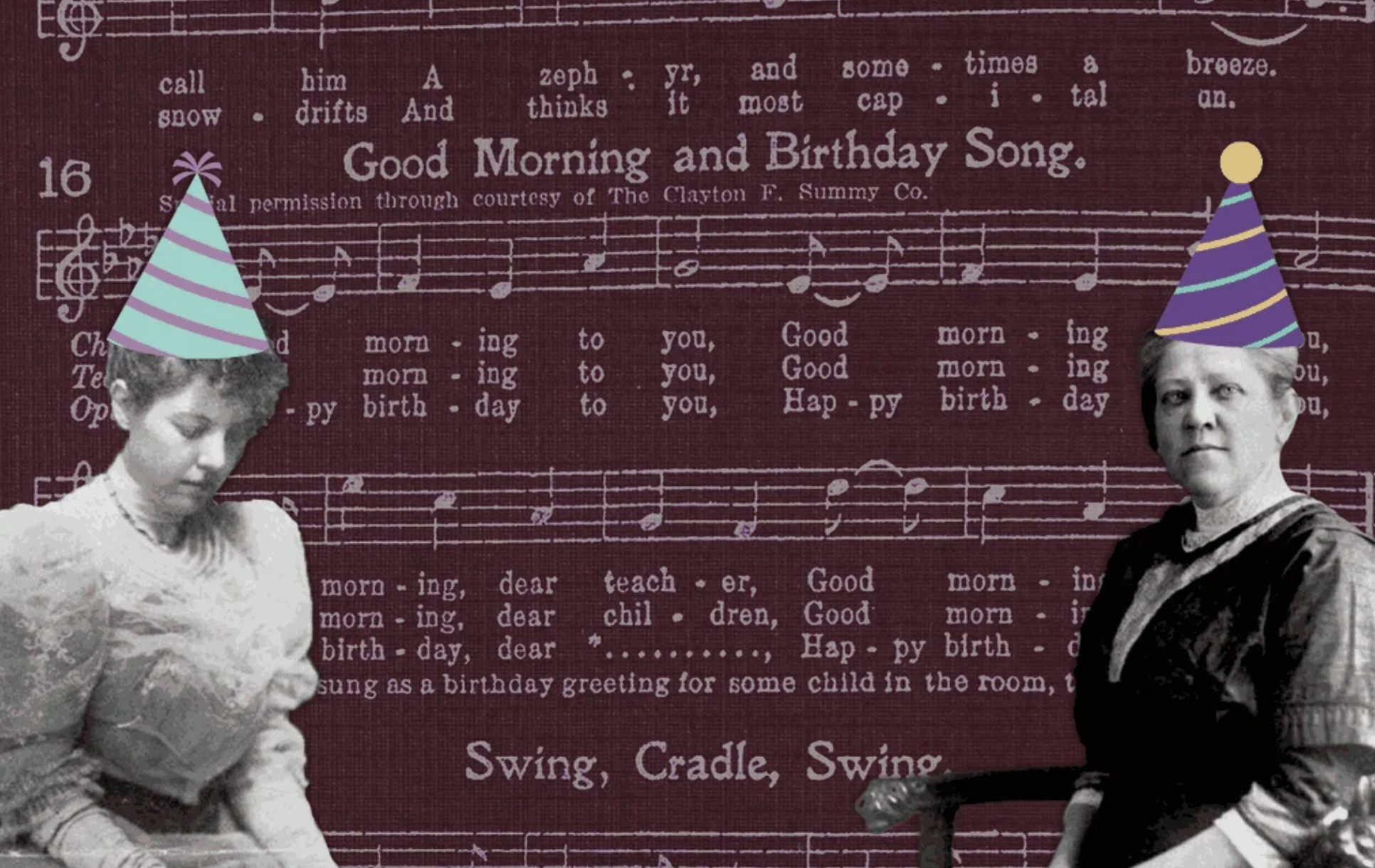
For the past century, people of all ages have sung a four-line jingle to mark their loved ones’ birthdays. But few know the names of the siblings behind this ubiquitous tune: Mildred Jane Hill, a renowned musician and songwriter, and Patty Smith Hill, a pioneer in early childhood education.
The surprisingly tangled history of “Happy Birthday to You”—described by Guinness World Records as the most frequently sung English-language song—begins in 1893, when the Hill sisters co-wrote and published a tune called “Good Morning to All.” Their goal, Patty later recalled, was to craft songs that expressed “those words and emotions and ideas fitted to the limited musical ability of a young child.”
Patty tested out the song, set to the same melody as “Happy Birthday,” on her kindergarten students in Louisville, Kentucky. The lyrics went like this: “Good morning to you / Good morning to you / Good morning, dear children / Good morning to all.”
How and when did these lines morph into “Happy Birthday”? Theories abound, but an element of the unknown persists. In Louisville, locals often trace the shift to the Little Loomhouse, a cabin that now houses a nonprofit fiber arts organization.
“The story goes that one or both of the sisters were at a birthday party at the summer cabin, and that’s where the lyrics were changed,” says Mick Sullivan, a curator at Louisville’s Frazier History Museum, which features a panel on the Hill sisters in its “Cool Kentucky” exhibition. “One of the points of the song was that you could just change it. Instead of ‘Good Morning to All,’ if it was Friday, they might say, ‘Good Friday to You.’”
Sullivan adds, “Children change lyrics all the time.” Consider, for instance, a popular parody of the birthday song: “Happy Birthday to you / You live in a zoo / You look like a monkey, / and you smell like one, too!”

A Louisville house where the Hill sisters lived in their youth Courtesy of the Happy Birthday Circle
“If a history of music in Kentucky were being written, a large portion should be devoted to the music of the Negro in our state,” Mildred wrote in a late 19th-century essay. “The old Negroes, who alone know this music, are fast dying out, and it is sad that some effort is not made to secure it before it is too late.”
Patty, meanwhile, was one of the most important education reformers in the United States, serving as the first president of the National Association for the Education of Young Children and a professor at Columbia University. She designed and marketed teaching tools called Patty Hill blocks, which kindergarteners used to build large play structures.
“What are you going to accomplish academically as a kindergartner?” Sullivan asks. The progressive philosophy “was about being with other kids and sharing that experience, [learning] cooperation and things that required multiple hands to do. That [approach] was really ahead of its time when you think about it.”
Mildred died in 1916 at age 56, long before her birthday composition’s meteoric rise to fame. Patty died in 1946 at age 78. The Hill sisters are buried near each other at Cave Hill Cemetery in Louisville.
In the 1920s, variations of “Happy Birthday,” set to the tune of “Good Morning to All,” appeared in several songbooks, including a 1924 one edited by Robert H. Coleman. As the song gained traction, even appearing in movies and aBroadway musical, Mildred and Patty’s youngest sister, Jessica Mateer Hill, decided to push back against unregulated use of the tune. In 1935, Jessica authorized the Clayton F. Summy Company, which had published the original Song Stories for the Kindergarten, to release a new copyrighted arrangement of “Happy Birthday.”
Decades of copyright disputes and lawsuits followed, with Warner Chappell Music—the music publisher that inherited the claim—fighting to retain the rights to the lucrative song. In 2016, a judge approved a settlementthat officially put “Happy Birthday” in the public domain.
In Louisville, the Happy Birthday Circle has raised $100,000 of the $8.7 million needed to build a public tribute to the Hill sisters at Waterfront Park. The project’s target groundbreaking date is 2026. The planned site—also called the Happy Birthday Circle—would feature a pavilion, a memorial and a picnic grove. It would be located under the Big Four Bridge pedestrian walkway, which connects Louisville to Jeffersonville, Indiana.
More than one million people cross the bridge annually, making it “a really great place to memorialize the Hill sisters, who have never been claimed by Louisville as the authors of the ‘Happy Birthday’ song,” says Rightmyer, who currently chairs the Happy Birthday Circle’s capital campaign. “We ask people in Louisville, ‘Do you know who wrote the “Happy Birthday” song?’ Maybe nine out of ten of them don’t. It’s the most sung song in the world.”