What the Forms Could Not Hold
Gabriele Micozzi is an Italian poet, fiction writer and essayist, born in Macerata in 1968 and living in the hills of the Marche, near the Adriatic. His work begins from a principle he calls Biodiversità Letteraria. A literary work is most alive when it behaves like an ecosystem: verse and data, lyric and citation, narrative voice and stage direction, scientific notation and prayer inhabit the same page because each changes what the others can say.
The ecological metaphor is structural, not decorative. Biodiversità Letteraria resists the cultural monoculture that asks writers, genres and even emotions to specialize. It also refuses to divide the author into incompatible selves: the mind that builds a spreadsheet can compose an elegy; the hand that writes a report can write a verse. For Micozzi, this plurality of languages is a civic act before it is a stylistic choice.
In this practice, the unfinished, the margin, the visible seam, typography and silence remain active parts of the work. The reader enters the spaces between forms and completes the ecology. FilmBook, a form developed by Micozzi, carries this principle into narrative: cinematic sequence, prose, poetry, stage directions and documentary materials belong to the same architecture, while framing, white space and the reader's movement across the page become part of the action.
His imagination is rooted in the Marche, where the hills seem to have been designed over centuries by farmers who never called themselves designers, and in Venice, a city he loves for turning fragility into architecture. Rock music and the 1980s form part of his private archive; visual art taught him that a page begins speaking before a sentence does. He reads across poetry, fiction, essays, reports and documents, drawn above all to works that refuse to remain inside the genre assigned to them.
That principle holds together four strands of his work: systemic horror, civic and ecological poetry, experimental fiction and essays on power. One question crosses them: what happens when a perfectly functioning structure meets what it cannot measure? In the horror, the monster is seldom supernatural; it is a procedure carrying out its assigned task. In the poetry, verified numbers encounter images that refuse to become statistics. In the essays, managerial and political language is examined where it governs while pretending merely to describe.
For more than twenty-five years Micozzi has worked inside organizations, boardrooms and classrooms, watching documents decide what happens to people. His writing reverses that direction: people enter birth certificates, factory orders, disciplinary charges, medication charts, customs declarations and wills, then leak out through the field that was never designed to hold them.
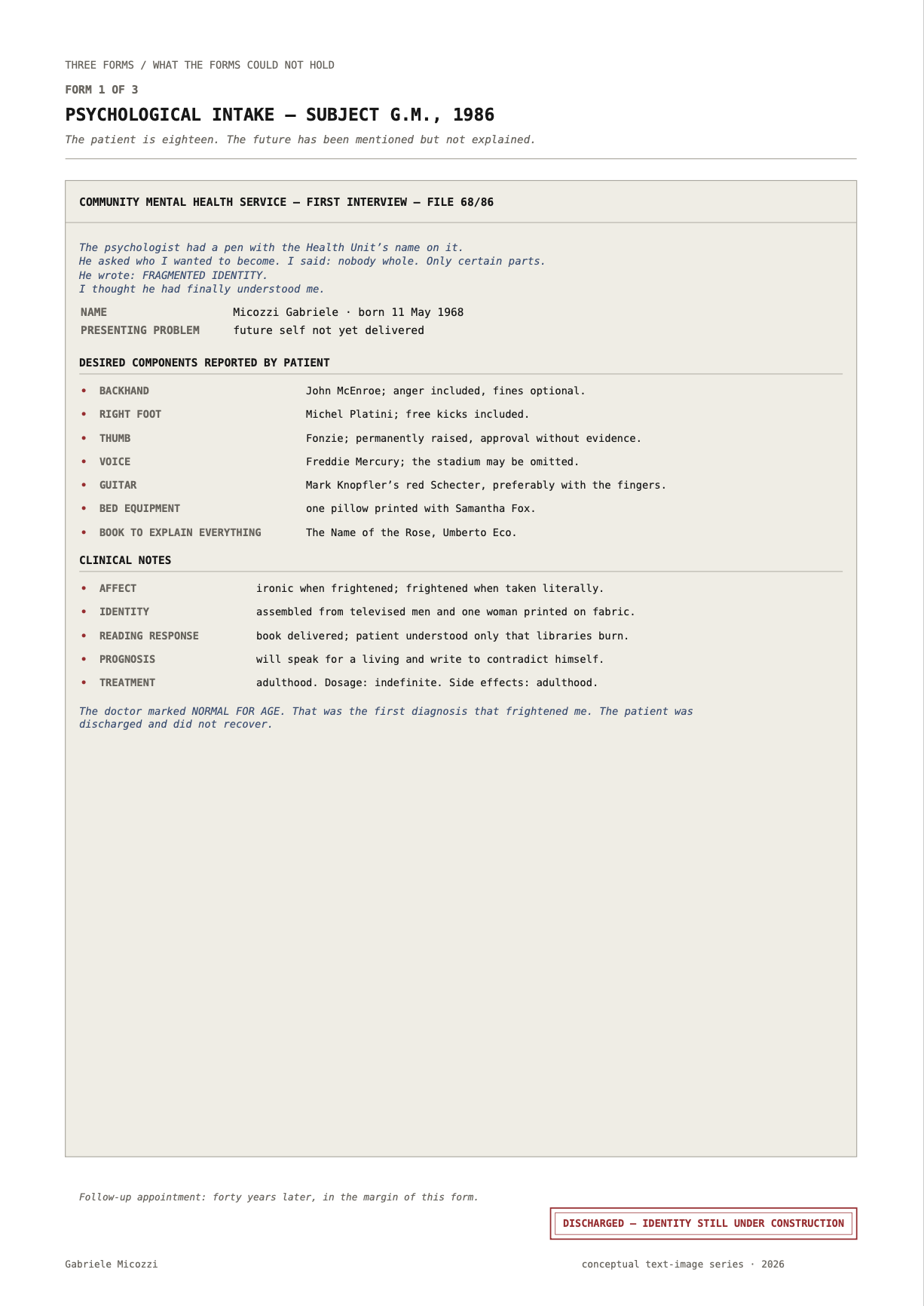
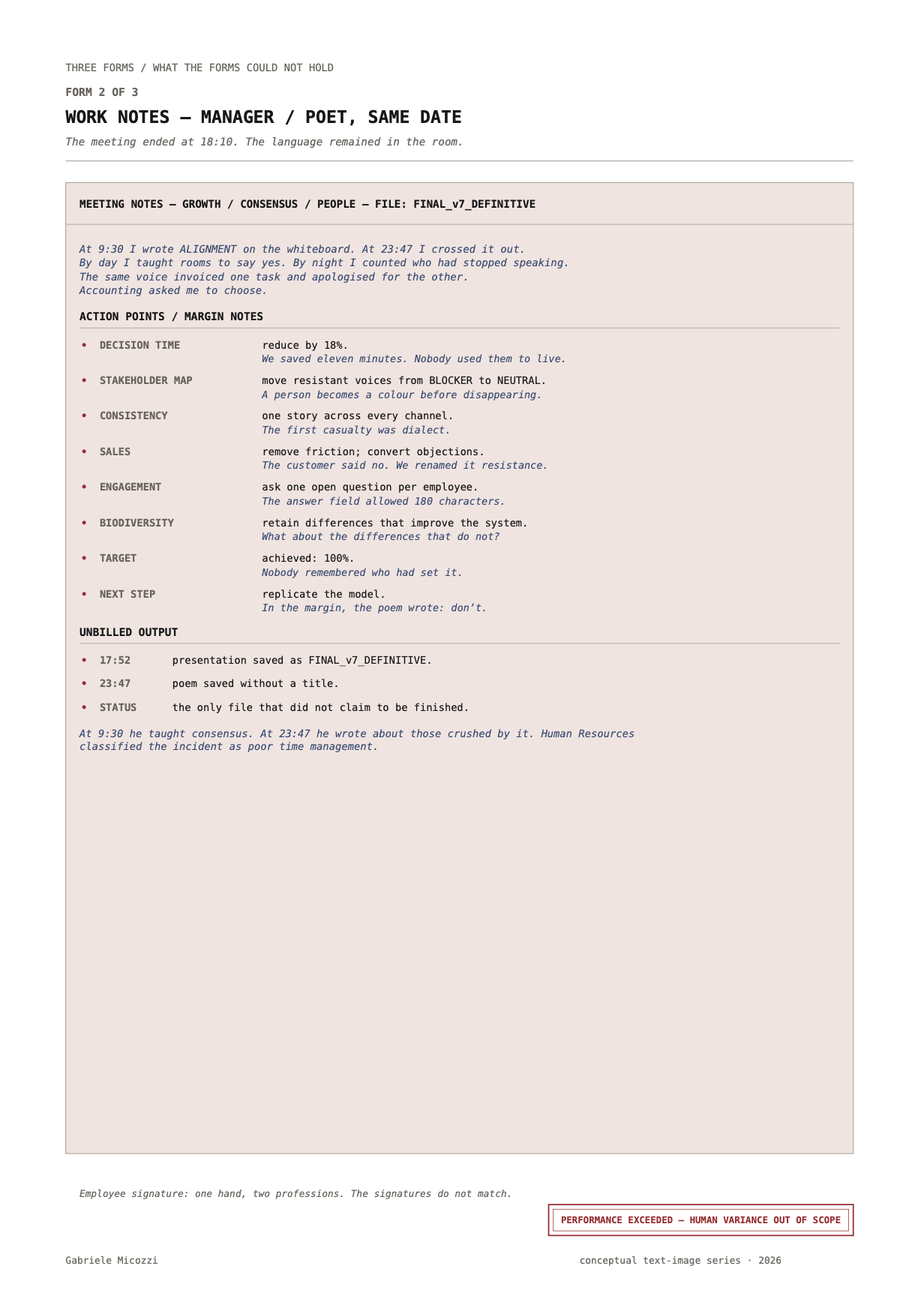
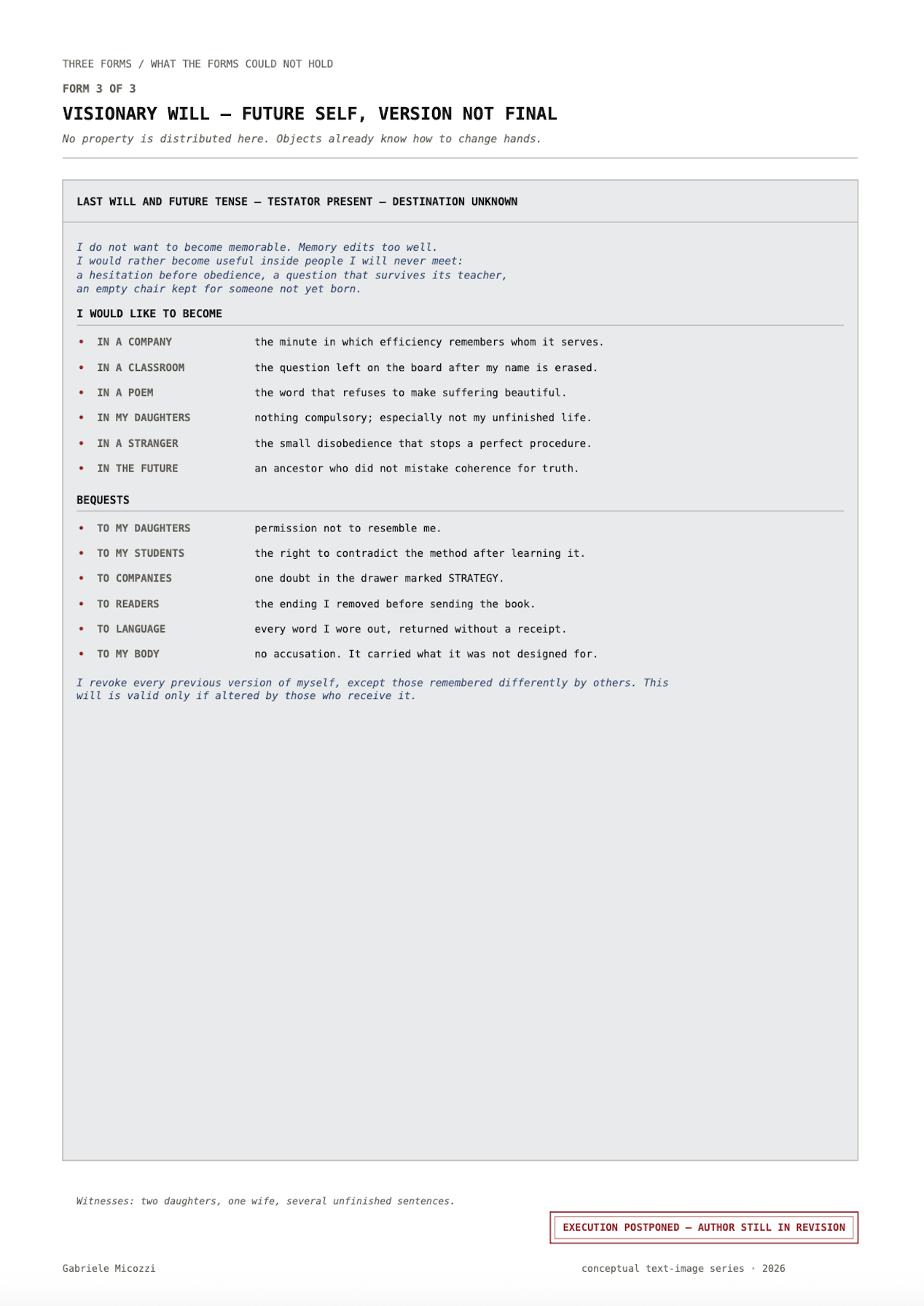
Three Forms: What the Forms Could Not Hold belongs to the documentary strand of this writing. Across three panels, a psychological intake form tries to diagnose an adolescent from the people he wants to borrow; meeting notes force managerial language to record its human cost; a visionary will distributes doubts and permissions instead of property. The forms remain functional. The person keeps escaping them. The series grows from two Italian works in progress: Certificato di esistenza in vita, thirty apocryphal documents following a life from its birth record to its death certificate, and In duplice copia, twenty-six poems written into the unused spaces of factory paperwork from 1979 to 1989.
Its ecological counterpart is Six Wastes, a sequence of certificates issued by an imaginary Anthropocene Bureau of Damages. The American journal ballast published the project as a stand-alone digital portfolio in issue 4.3, accompanied by an editorial, an interview and an audio reading. Another bilingual project, Inventario del Vivente / Inventory of the Living, places a verified number beneath every poem. The numbers are factual; the images are not. The work takes place in the unstable space between them.
Micozzi's essay "Biodiversità Letteraria: On Hybrid Form and the Page as Ecosystem" appeared in Asymptote's sixtieth issue in Summer 2026 and was later selected by the editors among the issue's highlights. OPEN: Journal of Arts & Letters has published his poetry, experimental fiction and performance writing, including "Inventory of the Grandmothers Who Stayed," nominated by the journal for a Pushcart Prize and given a dedicated close reading; "The Office of Human Remaining"; and the stand-alone pamphlet "Protocol for Declaring the Human Still Present."
His work has appeared or is forthcoming in Strange Horizons, American Poetry Journal, ONE ART, The Intima: A Journal of Narrative Medicine, Cathexis Northwest Press, Heavy Feather Review, The Ecological Citizen, Open Doors Review, parABnormal Magazine, Space and Time Magazine, Ta Adesa and the Bath Flash Fiction Award anthology. Poetry Lab Shanghai is preparing the first Chinese translation of his poetry for its Autumn 2026 issue.
In Italy, he is the author of the poetry collections Erosferica (Transeuropa, 2025), Appunti dalla divina tragedia (GFE, 2026) and Peccati, perversioni, preghiere (AttraVerso, 2025). IODIO, a collection of civic poetry, is forthcoming from Transeuropa in 2027.
He teaches language, communication and narrative technique at university and business-school level, examining how literary tools migrate into organizational storytelling and what they lose along the way. In 2026 he founded the Mental Imprint Literary Prize - Biodiversità Letteraria, a national competition inspired by Adriano Olivetti's decision to bring poets and writers inside the factory. Micozzi translates his own work into English.
Selected Links
Author website in Italian
https://www.gabrielemicozziautore.com/
Author website in English
https://www.gabrielemicozziautore.com/en/
Asymptote - Biodiversita Letteraria
https://www.asymptotejournal.com/criticism/gabriele-micozzi-biodiversita-letteraria-on-hybrid-form-and-the-page-as-ecosystem/
Asymptote - Summer 2026 Editors Highlights
https://www.asymptotejournal.com/blog/2026/08/03/summer-2026-highlights-from-the-team/
ballast 4.3 - Six Wastes
https://ballastjournal.com/issue-43-table-of-contents
OPEN Journal - Inventory of the Grandmothers Who Stayed
https://ojalart.com/poetry-all-forms-stylegabriele-micozziinventory-of-the-grandmothers-who-stayed/
OPEN Journal - Attending to the Quiet
https://ojalart.com/hal-heuristic-algorithmic-librarypoetry-all-forms-stylesa-featured-series-of-close-readingsattending-to-the-quiet-a-reading-of-gabriele-micozzis-inventory-of-the-gr/
OPEN Journal - The Office of Human Remaining
https://ojalart.com/prose-discourse-fictionshort-story-to-10000-wordsexperimental-forms-xpgabriele-micozzithe-office-of-human-remaining/
OPEN Journal - Protocol for Declaring the Human Still Present
https://ojalart.com/hot-button-press-contemporary-controversiespamphlet-seriesa-performance-protocolgabriele-micozziprotocol-for-declaring-the-human-still-present/
ONE ART - Thursday Taxi from Linate
https://oneartpoetry.com/2026/07/09/thursday-taxi-from-linate-by-gabriele-micozzi/
The Intima - Three Notes
https://www.theintima.org/three-notes-gabriele-micozzi-1
The Ecological Citizen - Rights from the Hearth
https://www.ecologicalcitizen.net/pdfs/epub-166.pdf
Kaidankai Podcast - Forty-Nine
https://www.kaidankaistories.com/
Mental Imprint Literary Prize
https://premio.marketingassociati.com/premi/
LinkedIn
https://www.linkedin.com/in/gabrielemicozzi/
Mental Imprint Literary Prize / Premio Letterario Mental Imprint
https://premio.marketingassociati.com/premi/