

Vanden Lande van Oversee (first strophe)
“Kersten man, wats di ghesciet?
Slaepstu? Hoe ne dienstu niet
Jhesum Christum dinen Here?
Peins, dogedehi dordi enich verdriet
Doe Hi Hem vangen ende crucen liet,
Int herte steken metten spere?
Tlant, daer Hi Zijn bloet in sciet
Gaet al tequiste alsmen siet.
Lacy, daer en is ghene were!
Daer houdt dat Sarracijnsce diet
Die keirke onder zinen spiet
Daerneder, ende doet haer groet onnere.
Ende di en dunkets min no mere?"
Translation
"Christian, what has happened to you?
Are you sleeping? Why are you not serving your Lord, Jesus Christ?
Think about it, did He not suffer for your sake,
when He let himself be captured and crusified,
and stabbed in the heart with a spear?
The Land where He has shed His blood
goes to pieces as you can see,
Alas, it is not being defended!
There the Saracens
suppress the church and hold a knife to her throat,
and violate her immensely.
And you do not care at all?"
”When you think about people who lived in the middle ages, you would not immediately imagine a well educated, self-thinking and critical person, who dared to speak his mind against his contemporaries, or the secular and sacred powers. The middle ages are beginning to no longer be considered as the Dark Ages, but does this apply to the ordinary medieval man and woman? In this webpage I will try to expound my point of view that there were well educated, contemplating middle agers, who were aware of what was happening in their world and had their own thoughts about it. The famous Flemish poet, Jacob van Maerlant (c. 1230–40 – c. 1288–1300) and his scalding poem Vanden Lande van Oversee (of the lands over the sea), about the loss of Acre, the last Christian stronghold in the Holy Land in 1291, will provide as a case study in this matter.
……
The poem Vanden Lande van Oversee (of the lands over the sea) of 247 lines, was one of Van Maerlants final works. Researchers like the Dutch linguist Frits van Oostrom, call the poet a pioneer in Diets (medieval Dutch) writing. Van Maerlant seemed to have a detailed view of what happened in Acre, and was convinced of the fact secular and sacred rulers were mostly to blame. The original written document of Vanden Lande does no longer exist. However there have been made many copies, from which Het Gronings Zutphense Maerlants handschrift (the Gronings Zutphens Maerlant handwriting), made in 1339 is the oldest. These 352 pages display multiple works of Van Maerlant decorated with beautiful miniature paintings, among them the Vanden Lande poem. Van Maerlants writings have been frequently clarified and translated into modern Dutch, particularly by the Dutch linguist Ingrid Biesheuvel in her work Maerlants Werk: Juweeltjes van zijn hand. For her translation she used the Gronings Zutphense Maerlants handschrift.
Source: this brilliant study from 2016 by third-year students from the University of Groningen in the Netherlands.
Note from the editors: we have tried to find the specific student who translated this first stanza from along the group that, so far as we can tell, collectively wrote the above mentioned study. But to no avail we’re afraid? If you are that student, or know (of) him/her/they, please let us know? You can do so right here! Dank je wel.
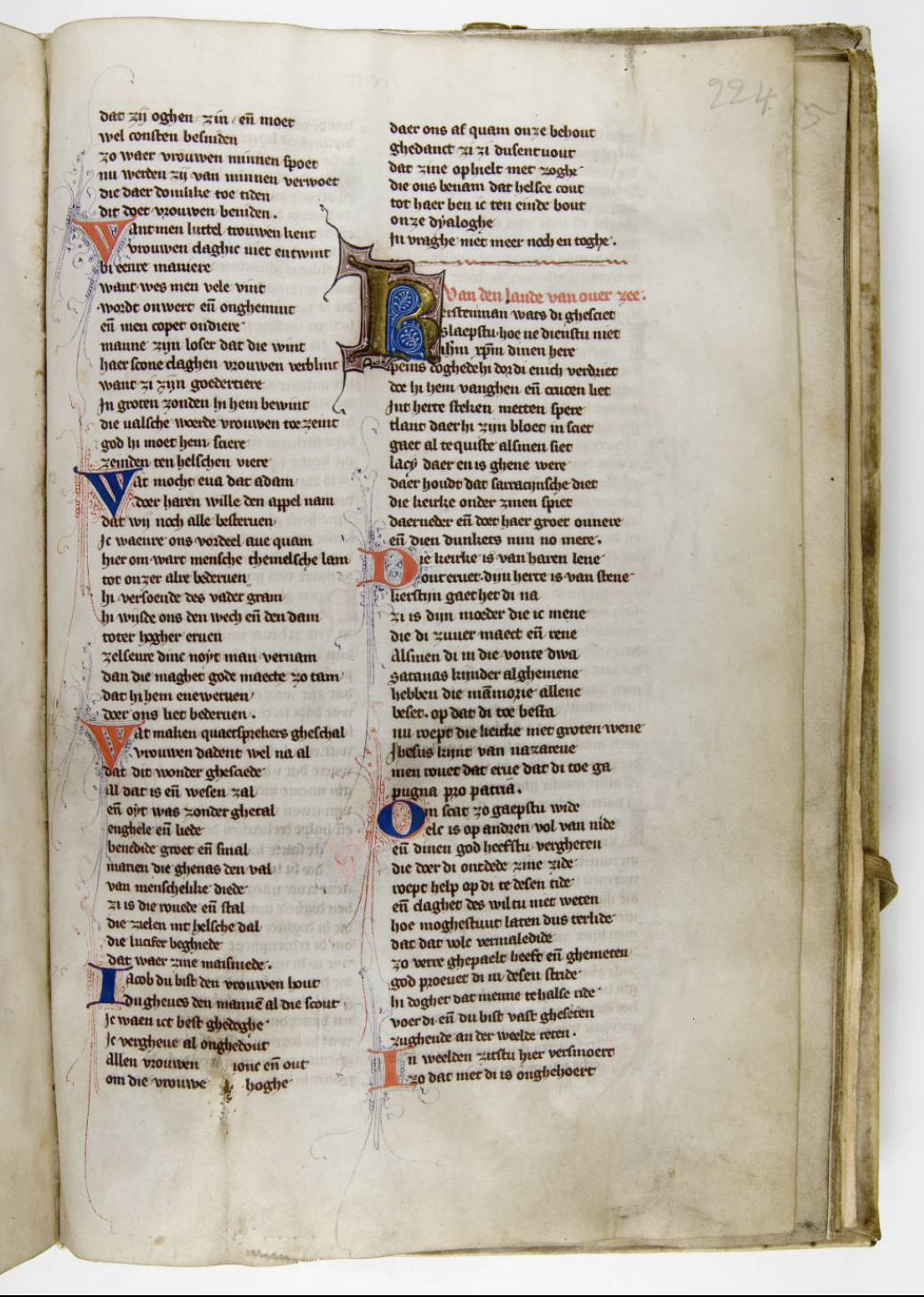
Opening page ‘Vanden Lande Oversee’ University library Groningen, Specialty collections, HS 405, f. 224r.