

Hebban olla uogala nestas hagunnan hinase hic enda thu uuat unbidan uue nu
"Hebban olla vogala", sometimes spelled "hebban olla uogala", are the first three words of an 11th-century text fragment written in Old Dutch. The fragment was discovered in 1932 on the back of the end-leaf of a manuscript that once belonged to the cathedral priory of Rochester, Kent, now Oxford, Bodleian Library, MS Bodley 340.[1]The manuscript contains a collection of Old English sermons by Ælfric of Eynsham. The Dutch text is found on fol. 169v and probably dates to the late 11th century.[2][3] It was long considered to represent a West Flemish variant of Old Low Franconian,[4] although more recent research shows that it also displays significant influence from Old English.[5]
An often-cited poem, it was long believed by many Dutch-speakers to be the only remaining text in Old Dutch. However, experts were already aware of other sources that were then not yet easily accessible. Today, more than 42,000 Old Dutch words and phrases from sources such as the Wachtendonck Psalms and the Leiden Willeram have been discovered, with the oldest definitive source being the Salian Law.[6]
The complete text, a probatio pennae or "scribble" by the writer to test his pen, is usually transcribed as Hebban olla uogala nestas hagunnan hinase hic enda thu uuat unbidan uue nu, although the manuscript text is very faded and many scholars differ slightly in their reading of the poem.[5] A word-for-word translation into Latin was written directly above it: (H)abent omnes uolucres nidos inceptos nisi ego et tu quid expectamus nu(nc). It is roughly translated as: "All birds have begun nests, except me and you – what are we waiting for now?" (Modern Dutch: Zijn alle vogels nesten begonnen, behalve ik en jij – waarop wachten we nu?)
Source: Wikipedia
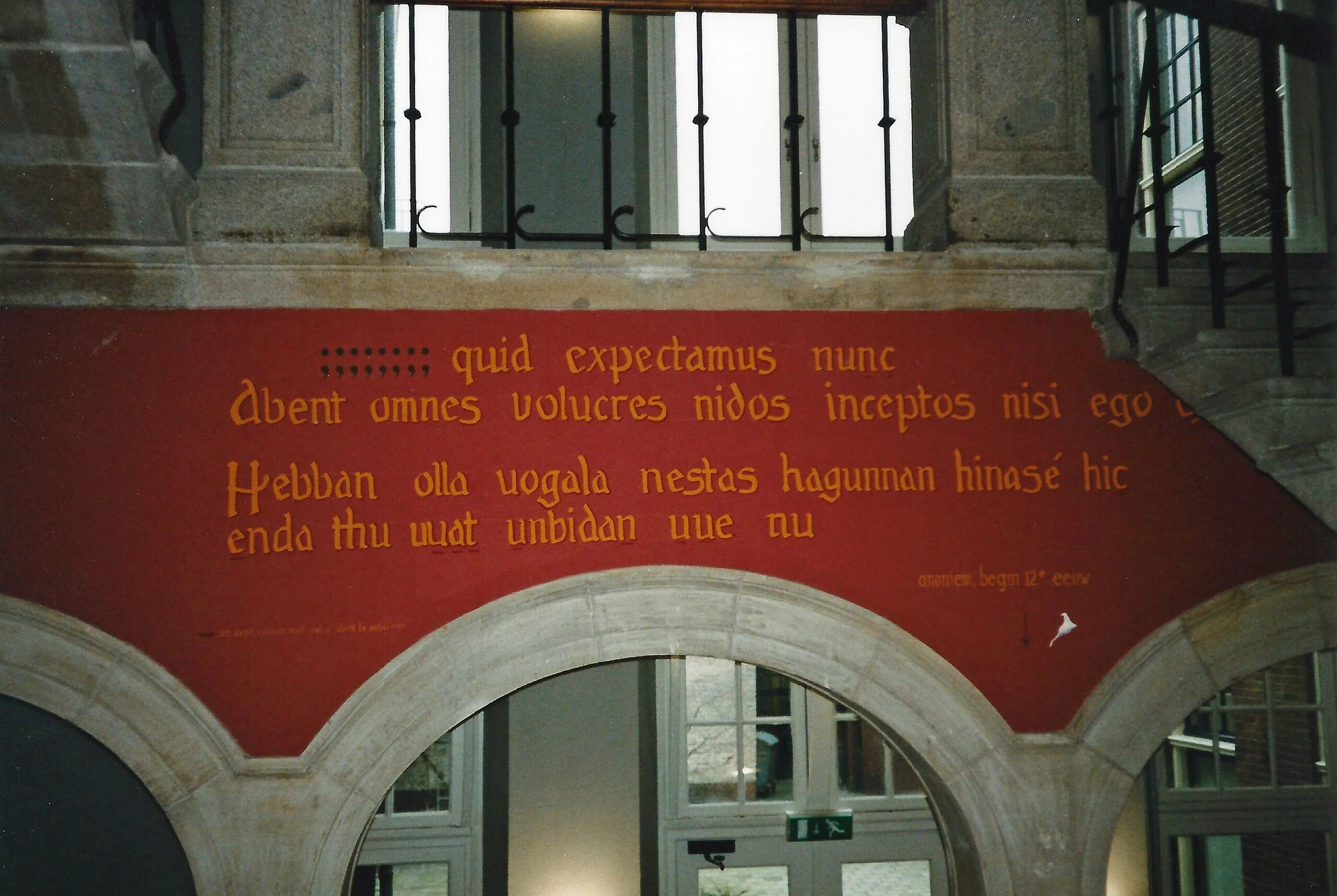
The first known poem in Old Dutch on a church wall in the city of Leiden