

STRANGE FRUIT
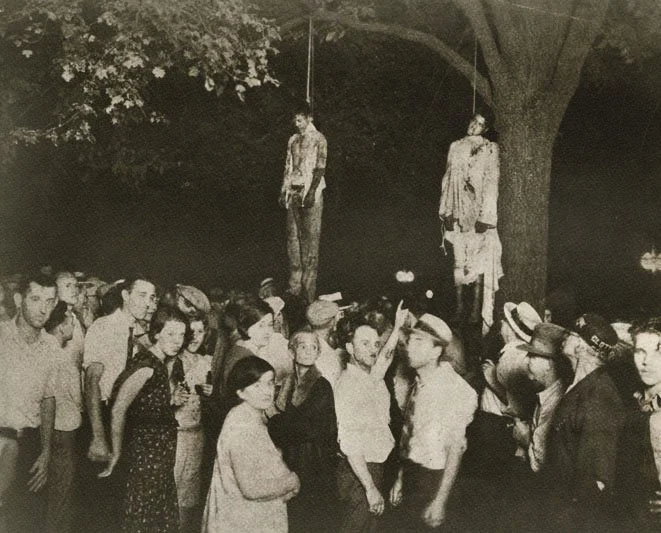
The lynching of Tom Shipp and Abe Smith in Indiana, August 7, 1930, photograph by Lawrence H. Beitler. NY Public Library, digital collections.
“Billie Holiday’s song “Strange Fruit” talks about lynching. It was inspired by a terrible, gruesome picture taken in 1930s of two Black men hanged from tree branches by their necks, surrounded by white men in fancy clothes. The song was originally written as a poem by a school teacher in New York City named Louis Allen. It’s a short poem that goes:
Southern trees bear a Strange Fruit
Blood on the leaves and blood at the root.
Black bodies swingin’ in the Southern breeze
Strange Fruit hangin’ from the poplar trees.
Pastoral scene of the gallant South
The bulgin’ eyes and the twisted mouth.
Scent of magnolias sweet and fresh
Then the sudden smell of burnin’ flesh.
Here is a fruit for the crows to pluck
For the rain to gather, for the wind to suck,
For the sun to rot, for the tree to drop
Here is a strange and bitter crop.
Mr. Allen wrote the poem in 1937, and a short time later he set it to music. According to Dr. Griffin, “He brought it to a young singer named Billie Holiday who had just started singing down at Café Society, which was the only integrated night club in New York City at the time.” Billie had been singing up until then in the segregated Black neighborhood called Harlem, but Dr. Griffin says the move to Café Society, “Was her big break and she was becoming a star.”
The song was instantly popular with the people in the audience, who were mostly people who supported the idea of giving rights to African Americans, but Billie—who knew what a terrible problem lynching was—decided she wanted to bring the song to a larger audience.
When Billie Holiday got up to sing this song, Dr. Davis says, “It had an enormous impact. This was really first time that, at least in popular music, such a powerful anti-racist stance had been assumed.” It is difficult today to express the risk Billie Holiday took to record the song. Black people lost their jobs all the time for standing up for the rights of their community. Teachers were fired, unions would bar Black activists from working on construction and plumbing jobs, and Black singers and actors could be barred from performing or dropped by their record labels. The decision to record “Strange Fruit,” Dr. Griffin says, was “very brave and courageous of a young artist who really put her career at stake by not only singing but recording this song, and she would do so again and again and again. I can’t think of another song until the 1960s that has the kind of political and emotional impact that “Strange Fruit” had and continues to have,” she says.”